WW II, Czechoslovak Concrete Fortress
Itinerary of the day tour:
History and Interesting Facts
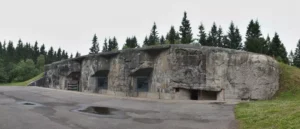
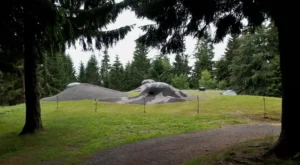
Before World War II, Czechoslovakia built an extensive system of border fortifications to defend itself against the growing threat of Nazi Germany. Construction began in 1935 and focused mainly on the mountainous border regions, where natural terrain could be combined with modern military engineering. The defensive line was inspired by contemporary fortification systems in Western Europe but was adapted to local conditions and strategic needs.
The fortification system consisted of two main elements: large artillery fortresses and thousands of infantry bunkers. Artillery fortresses, such as Hanička or Bouda, were massive underground complexes hidden inside hills, equipped with heavy guns, power systems, ammunition storage, and living quarters for hundreds of soldiers. Surrounding these strongholds were light and heavy infantry bunkers, positioned to control roads, valleys, and open terrain. By 1938, more than 10,000 infantry bunkers had been built, forming a dense defensive network.
Although these fortifications were designed to be nearly impregnable, they were never used in full combat. Following the Munich Agreement in 1938, Czechoslovakia was forced to abandon its border defenses without a fight. Today, the bunkers remain powerful reminders of the country’s determination to defend itself and stand as some of the most impressive examples of pre-war military engineering in Central Europe.
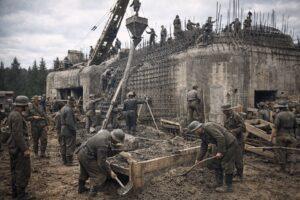
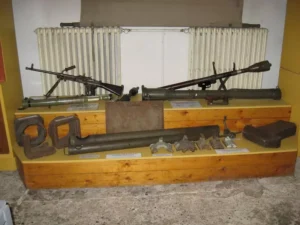
Hanička Fortress is one of the largest and most important pre-World War II fortresses in the Czech Republic and a key part of the former Czechoslovak border defense system. Built between 1936 and 1938 in the Orlické Mountains near today’s Polish border, the fortress was designed to protect a strategically important mountain pass and to form part of a continuous defensive line against Nazi Germany. Its remote forested location allowed the massive concrete structure to be carefully hidden within the landscape.
The fortress was constructed as a deep underground complex connected by several kilometers of tunnels. Inside, Hanička was designed to function as a self-sufficient military stronghold, equipped with artillery positions, ammunition storage, power generators, ventilation systems, and living quarters for hundreds of soldiers. Thick reinforced concrete walls and armored steel elements made the fortress extremely resistant to artillery fire, reflecting the high level of military engineering achieved by Czechoslovakia in the late 1930s.
Despite its strength and advanced design, Hanička was never used in combat. After the Munich Agreement in 1938, the fortress was abandoned without a fight, along with the rest of the border defenses. In later decades, it served various military purposes and was even considered for secret Cold War projects. Today, Hanička is open to visitors and stands as a powerful reminder of a nation that invested enormous effort into defending its independence, making it one of the most fascinating military monuments in Central Europe.