Jewish History, Terezín and Lidice
Itinerary of the day tour:
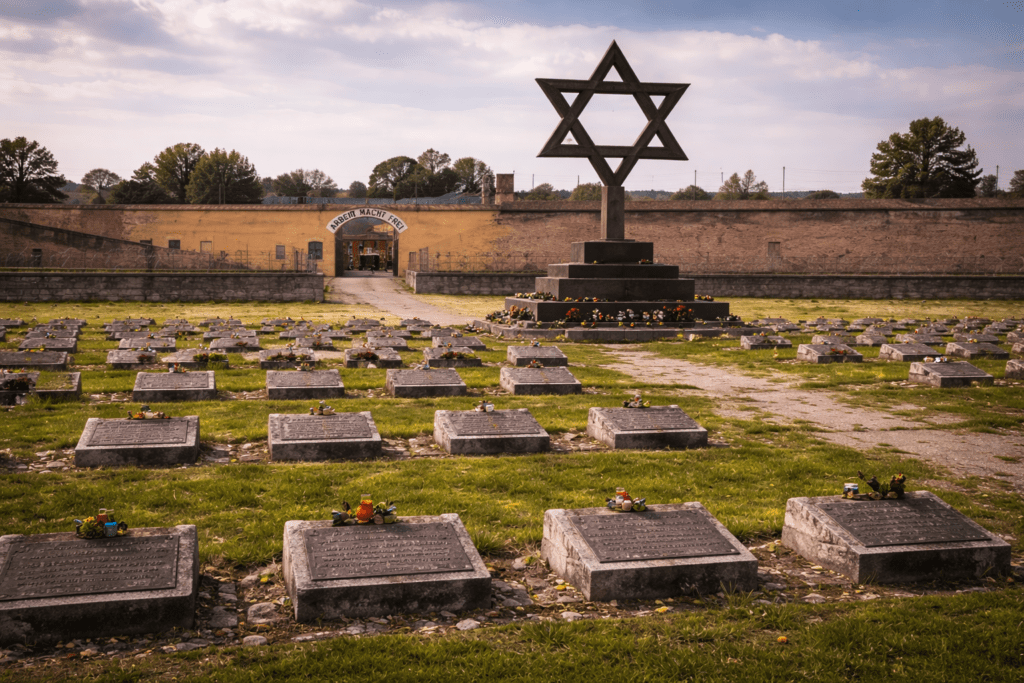
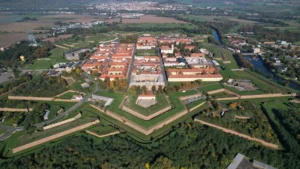
Terezín, also known as Theresienstadt, was originally built at the end of the 18th century as a military fortress by the Austrian Empire under Emperor Joseph II. Its main purpose was to protect the empire from attacks coming from the north. The fortress included strong walls, large barracks, gates, and an extensive system of underground corridors. Soldiers lived and trained there, and for many years Terezín served only a military role.
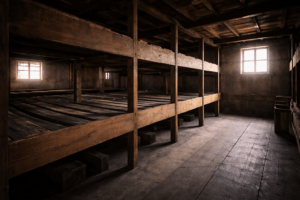
During World War II, the Nazis completely changed the purpose of this fortress. In 1941, Terezín was turned into a Jewish ghetto and transit camp. Jewish people from the Czech lands and many other European countries were imprisoned there. The camp was extremely overcrowded, food was scarce, and disease spread quickly. Many prisoners died inside the ghetto, and most were later deported to extermination camps such as Auschwitz. Despite the terrible conditions, prisoners tried to keep their dignity through culture, education, and art. Today, Terezín is a memorial and museum that reminds visitors of this tragic chapter in history and honors the victims of the Holocaust.
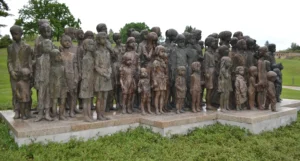
Lidice was a small Czech village that existed peacefully before World War II. People in Lidice lived ordinary lives, working mainly in agriculture and local industry. The village had houses, a church, a school, and strong community ties. Nothing about Lidice made it special or dangerous before the war.
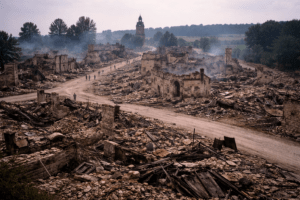
In 1942, after the assassination of Reinhard Heydrich, one of the highest-ranking Nazi leaders, the Nazi regime carried out brutal revenge actions. Although Lidice had no real connection to the attack, it was falsely accused of helping the resistance. As punishment, the village was completely destroyed. All men were executed, women were deported to concentration camps, and most children were murdered or taken away for forced Germanization. The buildings were burned and demolished, and Lidice was erased from maps. Today, Lidice is a memorial site that stands as a symbol of innocent suffering and a reminder of the cruelty of Nazi reprisals during World War II.
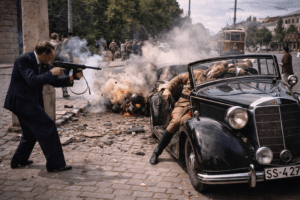
Operation Anthropoid was a secret resistance mission during World War II that led to the assassination of Reinhard Heydrich, one of the most powerful Nazi leaders and the acting ruler of occupied Czech lands. The operation was planned by the Czechoslovak government-in-exile and carried out by two trained Czechoslovak paratroopers, Jozef Gabčík and Jan Kubiš, who were sent from Britain.
On May 27, 1942, the attack took place in Prague. Heydrich was seriously wounded by a grenade and died a few days later. Although the operation was a major success for the resistance, it led to brutal Nazi reprisals, including the destruction of Lidice and Ležáky and the execution of thousands of innocent people. Operation Anthropoid remains one of the most important acts of resistance in occupied Europe and a powerful symbol of courage and sacrifice.